渋谷駅前のモヤイ
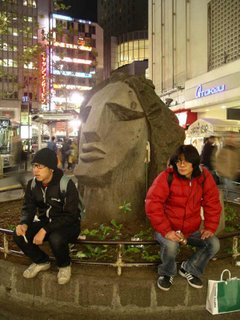 Waiting for a friend in Tokyo's Shibuya shopping district last night, I took a shot of this statue outside the west exit of Japan Rail's Shibuya station. It's a statue that serves as a rendevous spot, and is an example of what is called 'moyai' art from the island of Niijima (literally 'New Island') - one of the islands that make up the Izu Seven Islands about 180km south of Tokyo. 'Moyai' sculptures, this one included, are made from a pumice called 'koga', special to the island. The plaque beside it explains that 'moyai' is a word whose roots lie in the idea of getting together and co-operating, making it an art form particularly suited to forming the focal point of a meeting spot.
The similarity of 'moyai' to the statuary of Easter Island on the other side of the Pacific Ocean is amazing. However I am still not sure if Niijima's 'moyai' is a genuine art that is truly historically linked to that of Easter Island, or if it is a copy made possible by modern communications. Anyway, there it is in Shibuya, and most impressive in its big handsome simplicity.
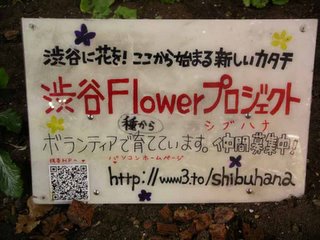 A stroll around it reveals another, flatter, face engraved on its reverse side. In the garden around it were seedlings that were only days old, and a handwritten sign advertising the Shibuya Flower Project that the garden represents, directing you to the Shibuya Flower project website - all in Japanese, but with lots of pictures showing the garden's evolution.
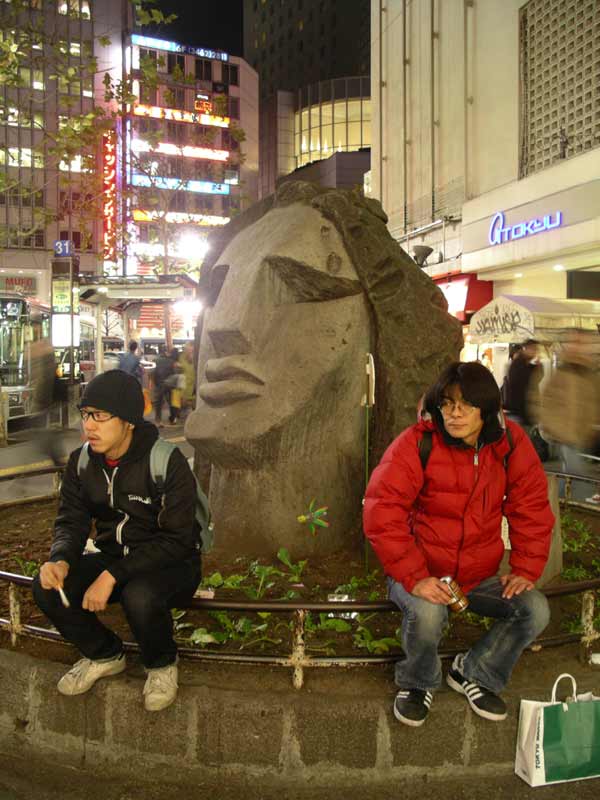 Waiting for a friend in Tokyo's Shibuya shopping district last night, I took a shot of this statue outside the west exit of Japan Rail's Shibuya station. It's a statue that serves as a rendevous spot, and is an example of what is called 'moyai' art from the island of Niijima (literally 'New Island') - one of the islands that make up the Izu Seven Islands about 180km south of Tokyo. 'Moyai' sculptures, this one included, are made from a pumice called 'koga', special to the island. The plaque beside it explains that 'moyai' is a word whose roots lie in the idea of getting together and co-operating, making it an art form particularly suited to forming the focal point of a meeting spot.
The similarity of 'moyai' to the statuary of Easter Island on the other side of the Pacific Ocean is amazing. However I am still not sure if Niijima's 'moyai' is a genuine art that is truly historically linked to that of Easter Island, or if it is a copy made possible by modern communications. Anyway, there it is in Shibuya, and most impressive in its big handsome simplicity.
 A stroll around it reveals another, flatter, face engraved on its reverse side. In the garden around it were seedlings that were only days old, and a handwritten sign advertising the Shibuya Flower Project that the garden represents, directing you to the Shibuya Flower project website - all in Japanese, but with lots of pictures showing the garden's evolution.
Post a Comment